Outdoor Lighting Standards Australia
Last updated: 25 October 2026
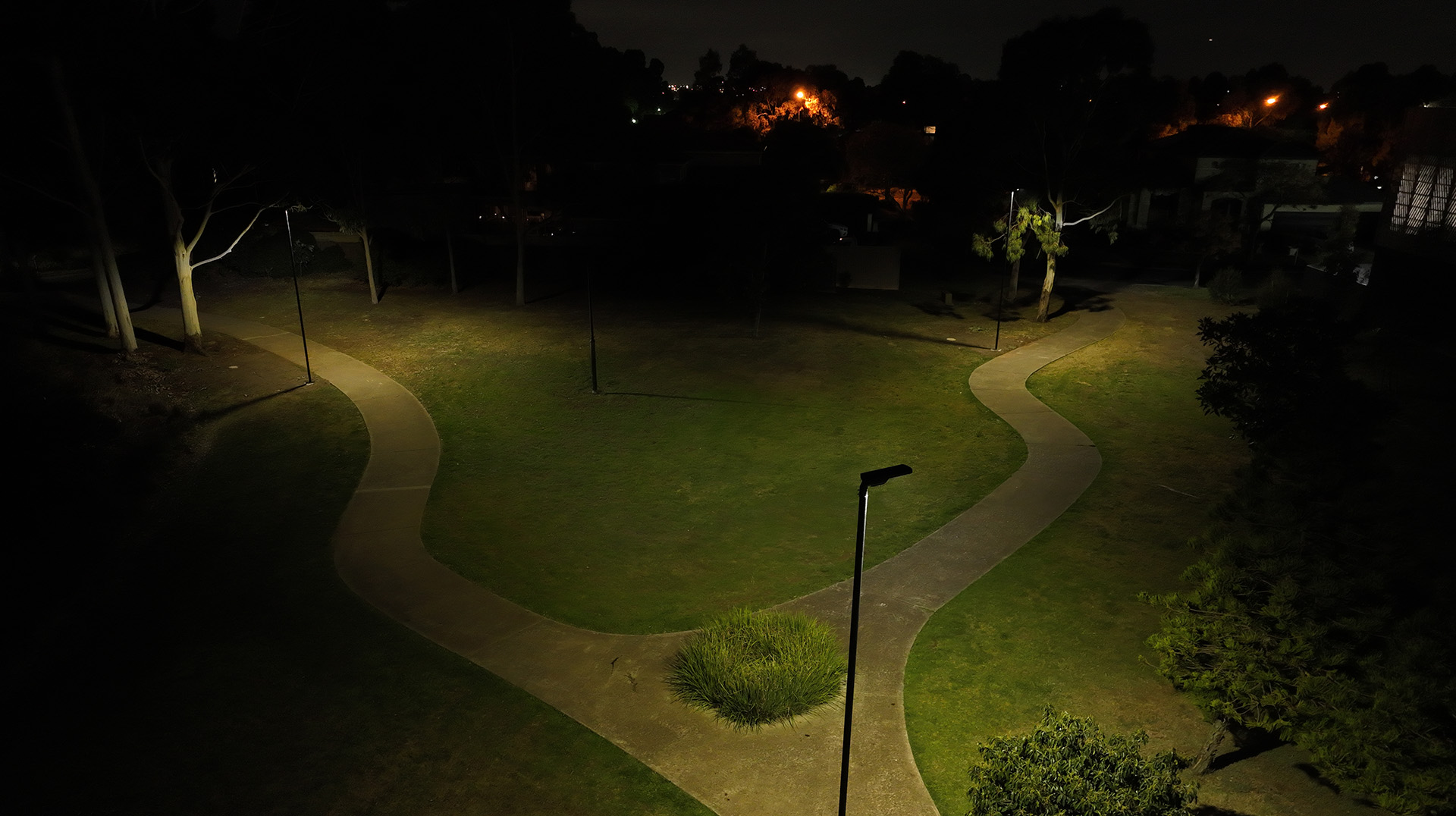
Outdoor lighting in Australia is changing as LED technology, smart controls, sustainability goals and greater awareness of light pollution influence how exterior spaces are designed and illuminated.
For lighting designers, contractors, developers and property owners, this also means navigating a range of Australian Standards covering roads and public spaces, outdoor workplaces, sports lighting and obtrusive light.
Understanding how these standards and technologies work together is becoming increasingly important when designing effective outdoor lighting.
Key Australian Standards for Outdoor Lighting Compliance
In Australia and New Zealand, outdoor lighting is governed by the following standards:
AS 1680.5 – Lighting for Outdoor Workplaces: This standard was introduced in 2012 and remains unchanged since. It covers lighting applications from general storage, varying degrees of pedestrian and traffic movement and assembly, fabrication, manufacturing or maintenance related tasks that are carried out at nighttime in exterior environments. Illuminance levels range from an average of 5 lux up to 80 lux.
AS 1158 Series – Lighting for Roads and Public Spaces: This series has existed since 1973 and was most recently revised in 2024. It is further sub-divided into lighting for vehicular traffic, pedestrian areas, pedestrian crossings, tunnels and underpasses. Latest changes in the standard since 2020 aim to harmonise the calculation methods, better define lighting categories, align standards with the changing of lighting technologies from HID to LED, introduce energy efficiency measures and improve compliance metrics.
AS 2560 Series – Sports Lighting: This series has existed since 1982 and has been updated over the years to align with technology changes and to include additional sports. Last updated in 2021, consolidating multiple individual sports standards into a single, more accessible standard. Another update to this series is expected soon, incorporating additional sports, making it a more comprehensive standard.
AS 4282 – Control of the obtrusive effects of outdoor lighting: AS/NZS 4282 provides guidance for controlling unwanted light spill, glare and other obtrusive effects from outdoor lighting. The 2023 revision also gives greater consideration to environmental impacts, including effects on flora and fauna.
For more detail, read our guide to AS/NZS 4282 and outdoor lighting design.
Beyond Australian Standards: Light Pollution and Dark Sky Initiatives
Apart from Australian Standards, there are independent bodies and rating systems which advocate and incentivise reduction of nighttime light pollution through various techniques. Some of the well-known ones are as follows:
Dark Sky International – It is a recognised global authority/movement on controlling light pollution. With advocates, volunteers and chapters all around the world, IDA raises awareness on how to protect the night skies by helping bodies formulate codes/standards/guides. It also runs certification programs for venues, designs and light fittings that aim to reduce nighttime light pollution.
The Australasian Dark Sky Alliance – Established in 2019, is a non-profit organisation which aims to raise awareness of impacts of light at nighttime on the environment. It offers guidance on best practices for nighttime lighting and has created a Certification Program for “ADSA Approved Light Fittings” which has three categories of good, better best i.e. ADSA Approved, ADSA Prized and ADSA Wildlife. enLighten’s outdoor range of products meet the criteria set by ADSA Approved fittings and can be customised to meet the requirements of ADSA Prized and ADSA Wildlife fittings.
Green Star – Founded in 2003, Green Star is a rating system that certifies sustainable developments on a scale of up to 6 Stars. It rewards projects that minimise light pollution. enLighten’s outdoor fittings can help secure up to the maximum available 2 points towards achieving a high rating for your building/premises through responsible exterior lighting design.
WELL Standard – Internationally acclaimed Standard launched in 2014 that has a people’s first approach to built environments. The Standard was developed and continues to evolve based on scientific and medical research.
Best Practices for Outdoor Lighting Design and Compliance
All above recommend controlling nighttime light pollution by one or more of the following techniques:
Control of upward waste light – To reduce sky glow from light sources by ensuring zero or near zero upward light spill. This is done by using correct optics and materials that control upward light from the luminaire.
Control of light spill beyond the site boundary – To avoid light spilling into adjacent properties or entering windows of residential dwellings beyond permissible limits. This is done through responsible design using luminaires with suitable optics and lumen outputs purposefully designed for different areas like pathway, roads to carparks to sporting avenues.
Control of glare – To minimise the perceived brightness from the fittings to people occupying the premises or present in its vicinity. This is done by ensuring that the luminance of the lights do not cross the permissible limits and while designing they are placed at optimal heights and orientations.
Control of colour of light – To use lower CCT light sources i.e. 3000K or below to preserve and cause minimal disturbance to flora and fauna. Special applications in environmentally protective zones for wildlife/sea-life may require using non-white colour tones such as amber or red. This is done by using suitable LED chips from reputable manufacturers.
Lighting control – Lights should only be on when needed or may increase or reduce their brightness as per the need of the space. Lighting controls, ranging from simple time clocks or daylight sensors to sophisticated web-based monitoring applications, can be used to ensure maximum energy efficiency and minimum light pollution.
enLighten's Approach to Outdoor Lighting
Effective outdoor lighting requires more than selecting a bright, energy-efficient luminaire. The fitting, optics, mounting position, controls and surrounding environment all influence the final result.
enLighten's approach considers light distribution, glare, spill light, energy efficiency and controls to help deliver outdoor lighting suited to the requirements of each project.
Where Outdoor Lighting Is Heading
Further standardisation across applications to streamline compliance and improve consistency.
Increased focus on sustainability, with stricter regulations on light pollution and efficiency.
Smart city integration, leveraging IoT and data analytics for better lighting management.
As outdoor lighting continues to evolve, enLighten remains committed to delivering solutions that enhance safety, performance, and sustainability. To learn more about how our products can help you stay compliant and energy-efficient, contact our team today.